Welcome to the Mathematical World!
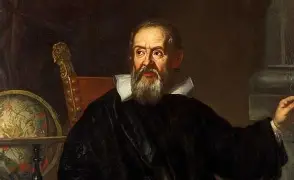
Galileo Galilei (1564 – 1642)
Pioneer of Experimental Science and Mathematical Physics
Galileo combined observation, experimentation, and mathematics to create the foundation of modern physics. His telescopic discoveries—such as the moons of Jupiter, the phases of Venus, and the rings of Saturn—provided strong evidence for the heliocentric model, directly challenging entrenched geocentric views.
He developed mathematical descriptions of motion, introducing concepts of uniform acceleration and inertia. For a body in free fall under gravity, Galileo described the distance traveled as: \[ s = \tfrac{1}{2} g t^2, \] where \(g\) is the acceleration due to gravity. This relation showed that falling bodies accelerate uniformly, regardless of their mass—contradicting Aristotelian physics.
Galileo also studied the motion of projectiles, showing that their paths follow a parabola: \[ y = x \tan \theta - \frac{gx^2}{2v^2 \cos^2 \theta}, \] where \(v\) is the initial velocity and \(\theta\) is the launch angle. This unification of horizontal and vertical motion marked a critical step in developing Newtonian mechanics.
His insistence on measurement and calculation as the foundations of science influenced generations of mathematicians, physicists, and engineers. Galileo also extended his work to instrument design, improving the telescope dramatically and creating precision tools for measurement.
By demonstrating that the natural world could be understood mathematically, Galileo laid the foundation for the scientific method, shaping how humans analyze and interact with the universe. Despite opposition and trial by the Church, his principles of reasoning and evidence-based inquiry endure as cornerstones of science and mathematics education.
Facts:
- Born in Pisa, Italy.
- Dramatically improved the telescope, enabling detailed astronomical observation.
- Observed Jupiter’s four largest moons (Io, Europa, Ganymede, Callisto) and the rings of Saturn.
- Advocated heliocentrism despite opposition from the Church.
- Developed mathematical descriptions of motion including acceleration and inertia.
- Known as the “father of modern science” for his experimental and mathematical methods.

All rights reserved by the Mathematical Unity
Contact: +8801400044645
Email: mathematicalhorse1453@gmail.com
Our Discord Server: Mathematical Unity [Ulus Riyadiyat]